 Save
Save I'll never forget the evening I discovered that a charcuterie board didn't need to be fussy or complicated to feel utterly luxurious. A friend had invited me to an intimate dinner party, and when I arrived, I found myself standing mesmerized by her board—not because of the abundance scattered everywhere, but because of what she'd left empty. The cheeses, meats, and fruits formed a glittering border around the edge of a gorgeous marble board, and the center was dramatically, intentionally clear. It felt like framing a work of art. That night, I learned that elegance isn't about filling every space—it's about knowing which spaces to honor with emptiness. Now, whenever I arrange this board, I'm transported back to that moment of quiet revelation.
I made this board for my sister's engagement party last spring, and watching twenty people gather around it, reaching for a sliver of manchego here and a fold of prosciutto there, I realized something had shifted. The empty center didn't feel sparse—it felt intentional, sophisticated, almost meditative. Everyone moved more slowly around this board, made more deliberate choices. There was space to breathe, literally and figuratively.
Ingredients
- Triple-cream Brie, 120 g, cut into slim wedges: This is your gateway cheese—creamy, approachable, and it melts on the tongue. Cut wedges rather than serving it whole so guests can take exactly what they want without feeling guilty.
- Aged Manchego, 120 g, sliced: Spanish sheep's milk cheese with a slightly nutty edge and a firmer texture that holds up beautifully on a board. It's the cheese that makes people pause and ask what it is.
- Blue cheese, 100 g, crumbled or sliced: This is your boldness. It punctuates the board with intensity. Don't shy away from it—the contrast is what makes the whole composition sing.
- Goat cheese, 100 g, formed into small rounds: A tangy counterpoint that feels special when shaped into little gems. If you can find one rolled in herbs or ash, even better—the visual distinction matters.
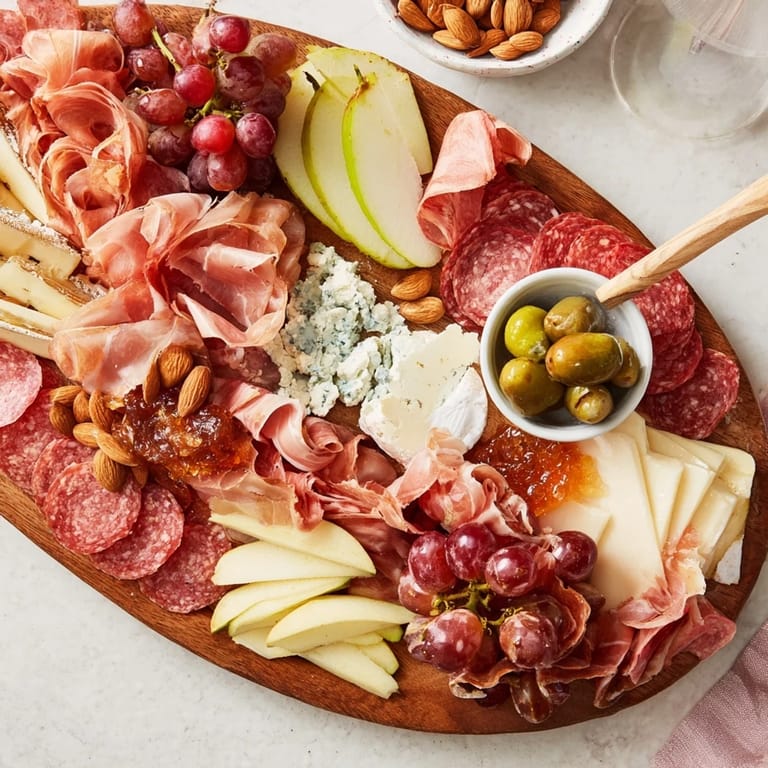
- Prosciutto, 100 g, folded into ribbons: Paper-thin and salty, it's the element that reminds everyone this is a celebration. Fold rather than lay flat so it catches the light.
- Thinly sliced salami, 120 g: Choose one with beautiful marbling—the visual pattern is part of the presentation. This is your reliable friend on any board.
- Coppa or bresaola, 100 g: Coppa is silky with fat that glistens; bresaola is leaner and almost floral. Pick whichever speaks to you, or do a mix for complexity.
- Red and green grapes, 1 small bunch each: They add jewel-tone color and a burst of juicy sweetness. Cluster them together for maximum visual impact.
- Pear, 1 ripe, thinly sliced: Slice just before serving so it doesn't brown. The delicate pale color creates a soft contrast against darker elements.
- Apple, 1 crisp, thinly sliced: Granny Smith or Honeycrisp works beautifully. The tartness balances all the richness, and the clean pale color echoes the pear.
- Dried apricots, 1 small handful: Their deep orange is a color no other ingredient provides. They add a chewy sweetness that creates little moments of discovery.
- Marcona almonds, 1/4 cup: These aren't the everyday almond—they're softer, richer, more buttery. They're worth seeking out specifically.
- Salted pistachios, 1/4 cup: The green brings unexpected color, and the salt enhances everything around them.
- Castelvetrano olives, 1/4 cup: Buttery and briny, they're milder than other varieties. Their jade green hue is striking.
- Cornichons, 1/4 cup: Tiny pickled cucumbers that serve as a palate cleanser. Their crunch and snap feel necessary.
- Fig jam or quince paste, 1/4 cup: This is your sweet-savory bridge. Fig jam feels more approachable; quince paste feels more dramatic. Choose your mood.
- Honeycomb or honey drizzle: If you can find honeycomb, the texture is magical. Otherwise, a generous drizzle of raw honey in a small bowl works beautifully.
- Baguette, 1, thinly sliced and lightly toasted: Toast just enough to add crispness and a subtle crunch without losing the tender crumb. The slight warmth of toast makes it feel intentional.
- Assorted crackers, 1 box: Choose varieties with different textures—some delicate, some sturdy. This is your vehicle for everything else.
Tired of Takeout? 🥡
Get 10 meals you can make faster than delivery arrives. Seriously.
One email. No spam. Unsubscribe anytime.
Instructions
- Choose Your Stage:
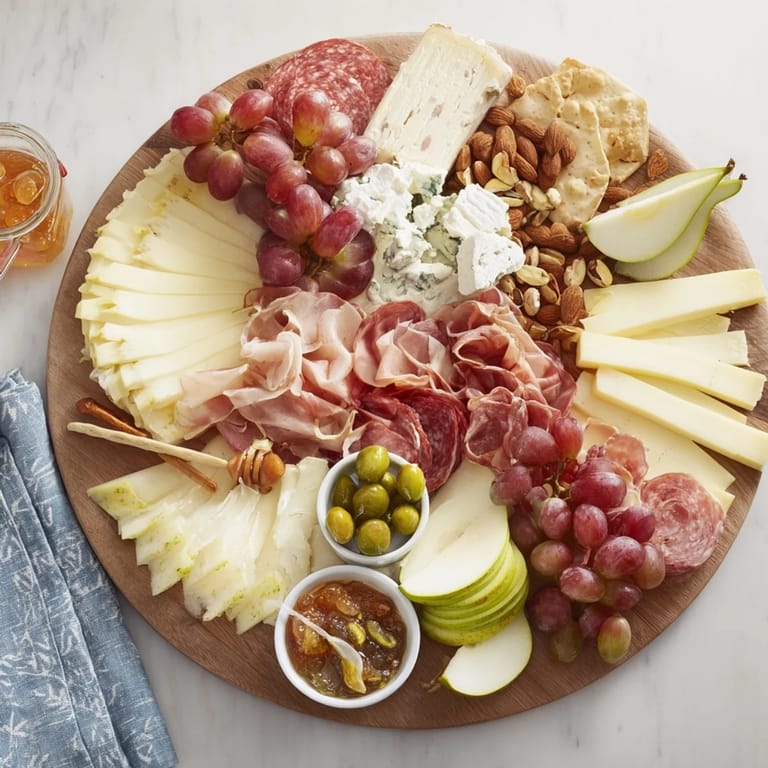
- Select a large round or oval board that speaks to you—marble, wood, ceramic, slate. The board itself is a character in this dish, so choose something with a personality and a prominent rim that can frame your arrangement. The rim is not decorative; it's structural. Everything you place will live here, along its edges, like a crown.
- Prepare Your Players:
- Slice your cheeses just before assembling—no more than fifteen minutes before—so they haven't begun to sweat or dry. Fold your prosciutto into loose ribbons. Slice your apple and pear last, just before you arrange, and if you're worried about browning, have a small bowl of lemon juice nearby to gently toss them in. Bring everything to room temperature, especially the cheeses. Cold cheese is a closed door; room-temperature cheese is an invitation.
- Map Your Border:
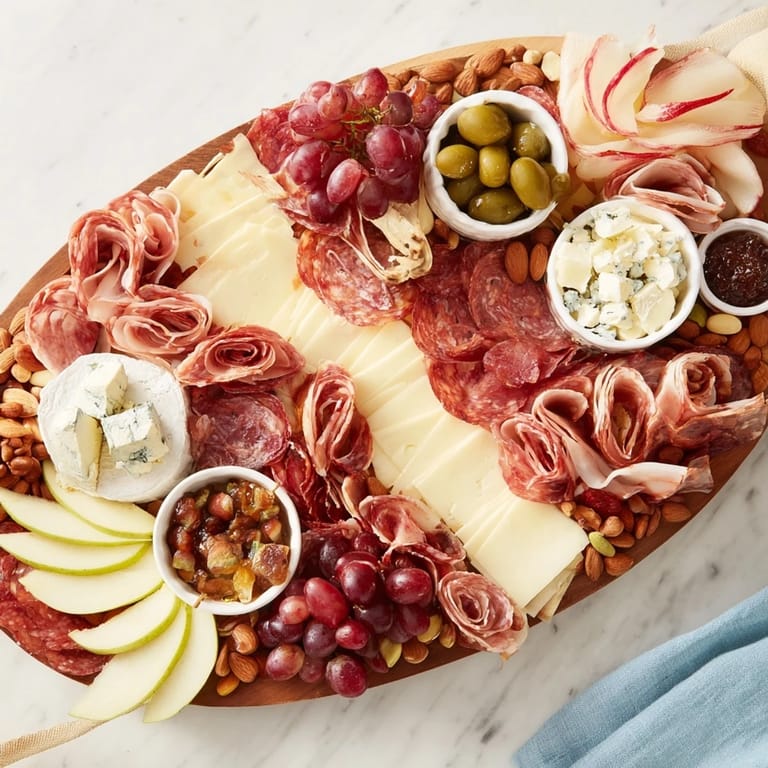
- Before you place a single thing, visualize the perimeter. You're not filling the board—you're framing it. Everything goes along the outer edge, following the natural curve of the rim. This is where restraint becomes elegance. The empty center isn't laziness; it's intention.
- Begin With Cheeses:
- Place your cheeses first, spacing them around the rim with intention. Distribute them so each one has its own small territory but feels part of a conversation. The Brie wedges might cluster together; the goat cheese rounds might be spaced evenly; the Manchego and blue cheese fill the gaps. Let them touch, but let them breathe.
- Weave In the Meats:
- Fold your prosciutto and arrange it in loose ribbons, letting it cascade and catch the light. Layer your salami and coppa or bresaola around the board, overlapping slightly but never obscuring. The meats should shimmer. If they look flat and dull, you're not done arranging yet.
- Scatter the Fruit:
- Grapes go in small clusters. Apple and pear slices can lean at angles for dimension. Dried apricots fill smaller gaps and add pockets of warm color. The fruit should feel like it was scattered by a generous hand, not placed by a grid.
- Build Texture With Nuts and Pickles:
- Almonds, pistachios, and cornichons fill the remaining gaps. These small elements create rhythm and texture variety. A handful of pistachios clustered together makes more impact than scattered singles. Cornichons can nestle between larger items.
- Anchor With Accompaniments:
- Place small ramekins or shallow bowls directly on the rim for your jam, honey, and olives. They're not hovering above the board; they're integrated into the composition. If you're using honeycomb, let it rest in a shallow dish. If you're drizzling honey, do it just before serving so it catches the light.
- Finish With Bread and Crackers:
- Prop your toasted baguette slices and crackers upright against the cheese and fruit, or tuck them into spaces along the rim. They should look abundant but not overwhelming—your guests will add more as the board empties. This is the final frame around your composition.
- Step Back and Assess:
- Walk away from the board. Look at it from across the room. Are there empty gaps that feel unintentional, or is the fullness of the rim balanced with the dramatic emptiness of the center? Does the eye want to travel around the edge? Adjust until it feels right. You'll know.
 Save
Save There was a moment, maybe three hours into my sister's party, when I watched my father—a man who usually rushes through food—pause in front of the board and just look at it. Not to grab something, but to appreciate it. He stood there for maybe ten seconds, which felt like a small eternity, and I realized this board had accomplished something beyond sustenance. It had slowed people down. It had made them present.
The Art of Restraint
The most transformative cooking lesson I've learned is that less is often more profound than more. This board teaches that lesson every time you arrange it. The empty center isn't empty at all—it's full of intention, of whitespace, of the confidence to say that what you've offered is enough. This philosophy extends beyond boards. It's about choosing your best ingredients rather than using every ingredient you own. It's about letting flavors speak rather than drowning them in complications. When you look at your finished board, you shouldn't see what you've added; you should feel what you've chosen to leave space for.
Wine Pairings That Transform Everything
The board itself is gorgeous, but wine is what turns it into a conversation. Champagne or sparkling wine feels celebratory and cuts through the richness of the cheeses and meats with bubbles and acid. A crisp Sauvignon Blanc brings minerality that echoes the salty elements and brightens the fruit. If you're serving this in winter, a dry rosé offers the best of both worlds—it's festive but not as heavy as red wine, and it won't overpower the delicate flavors you've so carefully arranged. The pairing matters because the board is an experience, and wine is the language that helps you have that experience fully.
Flexibility Within the Framework
This board is a blueprint, not a prison. Vegetarian? Remove the charcuterie and add marinated artichoke hearts, roasted red peppers, sun-dried tomatoes, or extra cheeses. In summer, swap the dried apricots for fresh apricots, add fresh figs if you find them, include fresh berries. In winter, lean into roasted nuts, dried fruits, and paste-like accompaniments. Want to add edible gold leaf to feel extra festive? Dust it over the manchego or the goat cheese rounds. These additions don't break the frame; they honor it by staying within the rim and keeping the center clear.
- If you're making this board for a smaller gathering, simply reduce quantities by half or a third and use a smaller board
- Set out small plates, napkins, and cheese knives before guests arrive so the experience feels graceful, not chaotic
- Make a simple card listing what you've chosen—people love knowing the name of that cheese that made them pause
 Save
Save This board has taught me that sometimes the most generous thing we can offer is not abundance, but clarity. The space to choose, to savor, to linger. That's what an elegant gilded edge board gives—not just flavors, but permission to slow down and notice.
Recipe Questions
- → How is the board arranged for visual appeal?
All items are carefully placed along the outer rim of the board, leaving the center empty to highlight its shape and create an elegant display.
- → What cheeses are included in the selection?
The board features triple-cream Brie, aged Manchego, blue cheese, and goat cheese, offering a range of textures and flavors.
- → Are there vegetarian alternatives available?
Yes. You can omit charcuterie and add marinated artichokes, roasted peppers, or extra cheeses for a vegetarian-friendly variation.
- → What accompaniments complement this board?
Marcona almonds, salted pistachios, Castelvetrano olives, cornichons, fig jam, quince paste, and honeycomb provide contrasting tastes and textures.
- → How should this board be served for best flavor?
Serve at room temperature to allow the cheeses and accompaniments to fully develop their flavors and textures.
- → What beverages pair well with this arrangement?
Champagne, sparkling wine, or a crisp Sauvignon Blanc are excellent pairings to complement the diverse flavors.